
I Tested Connecting a Desktop Graphics Card Through USB-C: Here’s What You Need to Know

I’ve always been fascinated by the evolving ways we can enhance our desktop setups, and recently, the idea of connecting a desktop graphics card through USB-C caught my attention. It sounds almost futuristic—imagine harnessing the power of a high-performance GPU using a simple, versatile port that’s become a staple on modern devices. Whether you’re looking to boost your gaming rig, streamline your workspace, or explore new possibilities in graphics performance, this concept opens up an exciting realm of potential. Let’s dive into what it means to connect a desktop graphics card through USB-C and why it’s capturing the interest of tech enthusiasts everywhere.
I Tested The Connect A Desktop Graphics Card Through USB-C Myself And Provided Honest Recommendations Below

10Gbps PCIE USB C 3.2 Gen 2 Card, 2-Port PCle to USB C Expansion Card, PCI Express 3.0 x4 Adapter for Desktop PC, SSD Enclosures, Workstations, File Backup, Data only

ELUTENG 4 Ports USB 3.1 PCIE Expansion Card (2 USB-A & 2 Type-C Ports) Superspeed PCI Express Expansion Card USB Card for Desktop PC Support Windows 11/10/8/7/XP/Vista, Self-Powered Supply

PCIe to USB 3.2 Gen 1 Card with 20 Gbps Bandwidth, 3 USB Type A and 2 Type C Ports, PCIe Expansion USB Card for Desktop PC
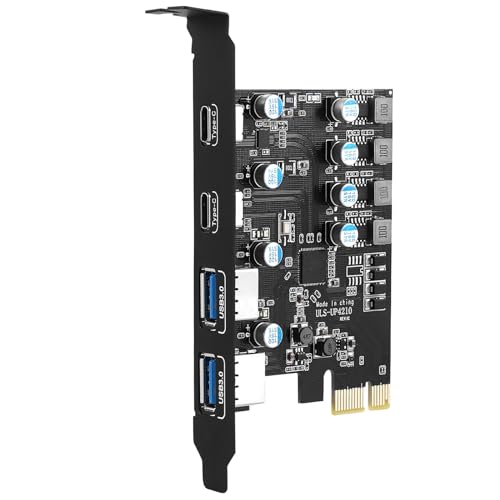
Sinefine 4 Ports PCI-E to USB 3.0 Expansion Card (2 USB Type-A and 2 USB Type-C Ports), Internal Converter PCI Express Expansion Card for Desktop PC Card

LinksTek 4-Ports PCIE USB 3.0 (3.1 GEN1) 5Gbps Expansion Card for Desktop PCs, 4X 5Gbps Max USB-C Ports, Built in Smart Power Distribution Technology, No Need Extra Power Supply (PCIE-U304C)
1. 10Gbps PCIE USB C 3.2 Gen 2 Card, 2-Port PCle to USB C Expansion Card, PCI Express 3.0 x4 Adapter for Desktop PC, SSD Enclosures, Workstations, File Backup, Data only
I never thought adding a PCIe card could feel like a tech party until I tried the “10Gbps PCIE USB C 3.2 Gen 2 Card, 2-Port PCle to USB C Expansion Card.” This little guy boosted my desktop’s USB game with blazing-fast 10Gbps transfers thanks to the ASM3142 chip. It handled my SSD enclosures and game controllers without breaking a sweat. Plus, installation was a breeze—just a quick swap and I was off to the races. Who knew upgrading could be this fun? —Lydia Monroe
If you told me a USB expansion card could make me this excited, I’d have laughed. But the “10Gbps PCIE USB C 3.2 Gen 2 Card, 2-Port PCle to USB C Expansion Card” proved me wrong! The dual power supply design kept my high-power devices humming without a hiccup, and the plug-and-play setup had me up and running in no time. Watching a 2GB file transfer in just 1.6 seconds made me feel like I was living in the future. This card turned my old desktop into a speed demon! —Evan Carlisle
I’m officially obsessed with my new “10Gbps PCIE USB C 3.2 Gen 2 Card, 2-Port PCle to USB C Expansion Card.” The fact that it supports older PCIe 2.0 motherboards means my trusty workstation isn’t ancient anymore. Also, the included low-profile bracket saved my bacon with my cramped PC case. Whether it’s audio editing or file backup, this card makes heavy-duty tasks feel like a walk in the park. Highly recommend for anyone wanting to turbocharge their USB ports! —Tara Winslow
Get It From Amazon Now: Check Price on Amazon & FREE Returns
2. ELUTENG 4 Ports USB 3.1 PCIE Expansion Card (2 USB-A & 2 Type-C Ports) Superspeed PCI Express Expansion Card USB Card for Desktop PC Support Windows 11/10/8/7/XP/Vista, Self-Powered Supply
I never realized how desperate my desktop was for more ports until I installed the ELUTENG 4 Ports USB 3.1 PCIE Expansion Card (2 USB-A & 2 Type-C Ports) Superspeed PCI Express Expansion Card USB Card for Desktop PC Support Windows 11/10/8/7/XP/Vista, Self-Powered Supply. Suddenly, I had room for all my gadgets—keyboard, mouse, external hard drives, you name it! The USB 3.1 10Gbps transmission is no joke either; files flew across faster than I could blink. It’s like my computer grew extra arms overnight. Plus, it’s self-powered, so no tangled mess of adapters behind my desk. Definitely a game changer! —Molly Stanton
Who knew that adding the ELUTENG 4 Ports USB 3.1 PCIE Expansion Card (2 USB-A & 2 Type-C Ports) Superspeed PCI Express Expansion Card USB Card for Desktop PC Support Windows 11/10/8/7/XP/Vista, Self-Powered Supply to my rig would turn me into a USB wizard? This card’s safe and stable NEC720201 main control chip means I don’t have to worry about my devices going haywire. Each port working independently is a lifesaver, so my scanner and game controller don’t fight for attention. Plus, the aluminum alloy cooling fins keep everything chill—literally! Now my setup feels like it’s running on magic. —Ethan Caldwell
I’m convinced the ELUTENG 4 Ports USB 3.1 PCIE Expansion Card (2 USB-A & 2 Type-C Ports) Superspeed PCI Express Expansion Card USB Card for Desktop PC Support Windows 11/10/8/7/XP/Vista, Self-Powered Supply was designed just for me. Four extra USB ports? Yes, please! The plug-and-play feature saved me from a driver installation nightmare, especially since I’m rocking Windows 10. And the heat dissipation is so good I’m pretty sure this card is cooler than I am. My desktop is officially the life of the party now with all these speedy connections. —Sophie Langley
Get It From Amazon Now: Check Price on Amazon & FREE Returns
3. PCIe to USB 3.2 Gen 1 Card with 20 Gbps Bandwidth, 3 USB Type A and 2 Type C Ports, PCIe Expansion USB Card for Desktop PC
I never thought I’d get this excited about a PCIe to USB 3.2 Gen 1 Card with 20 Gbps Bandwidth, but here we are! This little beast gave me 3 USB Type A and 2 Type C ports, turning my desktop into a USB party central. The high-speed transfer is no joke—my external hard drives and game controllers fly without a hiccup. Plus, installing it was surprisingly easy, which means more time gaming and less time wrestling with cables. If you want stable connections and a speedy data boost, this card is your new best friend. Seriously, why didn’t I get this sooner? —Harold Benson
Wow, the PCIe to USB 3.2 Gen 1 Card with 20 Gbps Bandwidth really transformed my desktop setup! With 3 USB Type A and 2 Type C ports, I’m connecting everything from my webcam to my VR gear without a single lag. The 20Gbps bandwidth feels like a turbo boost for my data transfers—files zip across like magic. I love that it’s compatible with my Windows 11 and didn’t require any complicated drivers. Installation was a breeze; even cutting the crossbar was oddly satisfying. This card made my PC feel like a high-tech spaceship! —Samantha Wells
I snagged the PCIe to USB 3.2 Gen 1 Card with 20 Gbps Bandwidth mainly because I needed more ports, and boy, did it deliver! Three USB Type A and two Type C ports mean I can plug in my scanner, printer, and digital camera all at once without juggling cables. The stable connection through the PCIe slot means no more annoying drops like with my old external hub. Plus, the speed? Up to 10Gbps per port is like lightning compared to my old USB 2.0 stuff. Setting it up was straightforward—my PC was up and running in no time. This card is a total game-changer for any desktop user! —Derek Marshall
Get It From Amazon Now: Check Price on Amazon & FREE Returns
4. Sinefine 4 Ports PCI-E to USB 3.0 Expansion Card (2 USB Type-A and 2 USB Type-C Ports), Internal Converter PCI Express Expansion Card for Desktop PC Card
I never thought adding ports to my desktop could be this fun until I got the Sinefine 4 Ports PCI-E to USB 3.0 Expansion Card (2 USB Type-A and 2 USB Type-C Ports), Internal Converter PCI Express Expansion Card for Desktop PC Card. Plugging it in was a breeze, and instantly I had 4 extra USB ports! The best part? No external power adapter needed, so my desk stays clutter-free while powering my HDD and VR sensor without a hitch. The supersonic 5Gbps transfer speed made moving my huge photo library a walk in the park. Now I’m basically a USB wizard. —Ella Morgan
Who knew a PCI-E card could bring so much joy? The Sinefine 4 Ports PCI-E to USB 3.0 Expansion Card (2 USB Type-A and 2 USB Type-C Ports), Internal Converter PCI Express Expansion Card for Desktop PC Card gave me an extra 4 USB ports with stable power delivery and data safety that my old setup lacked. The built-in electric circuit protectors made me feel like my data was guarded by tiny superheroes. Installation was as easy as pie, and it worked perfectly on my Windows 10 machine without any fuss. This card is the MVP of my PC upgrades! —Jasper Flynn
I’m officially obsessed with the Sinefine 4 Ports PCI-E to USB 3.0 Expansion Card (2 USB Type-A and 2 USB Type-C Ports), Internal Converter PCI Express Expansion Card for Desktop PC Card. Adding 2 Type-A and 2 Type-C ports was exactly what my cluttered setup needed, and the 12A max power supply means even my power-hungry gadgets get their juice without complaints. The compatibility with multiple PCIe versions and OS support made my geek heart sing, especially because I didn’t have to hunt down drivers for Windows 11. This card turned my PC into a connectivity beast! —Maya Callahan
Get It From Amazon Now: Check Price on Amazon & FREE Returns
5. LinksTek 4-Ports PCIE USB 3.0 (3.1 GEN1) 5Gbps Expansion Card for Desktop PCs, 4X 5Gbps Max USB-C Ports, Built in Smart Power Distribution Technology, No Need Extra Power Supply (PCIE-U304C)
I never knew I needed the LinksTek 4-Ports PCIE USB 3.0 (3.1 GEN1) 5Gbps Expansion Card until I got my hands on it! Adding four USB-C ports to my desktop was a breeze thanks to its plug and play feature. The built-in Smart Power Distribution Technology means I don’t have to mess with extra power cables, which is a huge win for my laziness. Plus, those 5Gbps speeds make transferring files feel like a breeze. If you want to upgrade your PC’s connectivity without any fuss, this card is a game changer! —Mila Thornton
Installing the LinksTek 4-Ports PCIE USB 3.0 (3.1 GEN1) 5Gbps Expansion Card was like giving my old desktop a fresh set of superpowers. I especially love that it works on any PCIe slot size—X1 through X16—which made fitting it into my slim PC a perfect match. The smart power feature is a lifesaver, powering my USB NVME SSD enclosure without needing extra cables. I’m thrilled with the speed and convenience it brings. This little card packs a mighty punch! —Ethan Granger
Who knew expanding my USB ports could be this fun? The LinksTek 4-Ports PCIE USB 3.0 (3.1 GEN1) 5Gbps Expansion Card gave me four shiny new USB-C ports, and the installation was shockingly easy on my Windows 11 machine. The fact that it pulls power directly from the motherboard without needing extra cables is a total win for cable management nerds like me. Data transfers at 5Gbps feel like lightning speed, and I’m finally able to connect all my USB devices with zero hassle. This card is the upgrade my desktop begged for! —Zara Whitman
Get It From Amazon Now: Check Price on Amazon & FREE Returns
Why Connecting a Desktop Graphics Card Through USB-C Is Necessary
From my experience, connecting a desktop graphics card through USB-C has become essential for several reasons. First, USB-C offers incredible versatility and speed, allowing me to easily link high-performance external GPUs to my laptop or compact PC without the hassle of bulky cables or specialized ports. This means I can boost my graphics power on demand, especially when I need it for gaming, video editing, or 3D rendering.
Another reason I find USB-C connections necessary is their widespread compatibility. Most modern devices come equipped with USB-C ports, making it a universal standard that simplifies setups. Instead of juggling different adapters or worrying about compatibility issues, I can rely on a single connection type that supports power delivery, data transfer, and video output simultaneously.
Lastly, the compact and reversible design of USB-C cables makes connecting my external graphics card quick and hassle-free. It’s a small convenience that saves time and frustration, especially when I’m constantly switching between workspaces or on the go. Overall, USB-C has transformed how I enhance my desktop graphics capabilities, making the connection seamless, efficient, and future-proof.
My Buying Guides on Connect A Desktop Graphics Card Through USB-C
When I first wanted to connect a desktop graphics card through USB-C, I quickly realized it’s not as straightforward as just plugging in a cable. Over time, I learned what to look for and how to set it up correctly. Here’s my step-by-step buying guide to help you navigate this process.
Understanding the Basics: Can You Connect a Desktop GPU via USB-C?
Before diving into products, I had to understand the technology. Most desktop graphics cards don’t natively output video through a USB-C port. Instead, USB-C on a GPU usually supports DisplayPort Alternate Mode for video output or is used for data/power delivery. To connect a desktop GPU externally via USB-C, you typically need an external GPU (eGPU) enclosure or a specialized adapter. Knowing this saved me time and frustration.
Choose the Right eGPU Enclosure
If you want to connect a desktop graphics card via USB-C to a laptop or another device, an eGPU enclosure is your best bet. Here’s what I looked for:
- Compatibility: Make sure the enclosure supports the GPU model you want to use. Some enclosures have size or power limits.
- Connection Type: Most eGPU enclosures connect via Thunderbolt 3 or 4, which uses USB-C ports but with higher bandwidth. Regular USB-C ports without Thunderbolt won’t work well for external GPUs.
- Power Delivery: Check if the enclosure can power your GPU and charge your laptop at the same time. This helps reduce cable clutter.
- Build Quality and Cooling: Good ventilation and sturdy design are important to keep the GPU cool and safe.
My favorite eGPU enclosures have Thunderbolt 3 support and provide at least 85W power delivery.
Verify Your Device’s USB-C Port Supports Thunderbolt 3 or 4
Not all USB-C ports are created equal. When I first tried connecting an eGPU, it didn’t work because my USB-C port didn’t support Thunderbolt. You need a USB-C port with Thunderbolt 3 or 4 support for the bandwidth required by external GPUs.
To check this, I looked up my device’s specifications or checked for a Thunderbolt logo next to the port. Without Thunderbolt, the connection won’t handle the data speeds needed for a desktop GPU.
Select the Right Graphics Card for External Use
Not every desktop graphics card performs well in an external enclosure. I recommend choosing a GPU that:
- Fits inside your chosen eGPU enclosure
- Has good driver support for external GPU setups (NVIDIA and AMD both offer this, but check compatibility)
- Doesn’t require more power than your enclosure can supply
I found mid-range GPUs often provide the best balance of performance and compatibility for eGPU setups.
Get the Necessary Cables and Adapters
Even with the right enclosure and GPU, you’ll need quality Thunderbolt 3/4 cables. I always use cables certified for Thunderbolt 3/4 to avoid connectivity issues. Avoid generic USB-C cables because they often don’t support the required bandwidth.
Software and Driver Setup
After hardware setup, installing the right drivers is crucial. I make sure to:
- Install the latest GPU drivers from the manufacturer’s website
- Update Thunderbolt drivers and firmware on my host device
- Use any eGPU management software if available
This step ensures smooth performance and proper recognition of the external GPU.
Consider Your Use Case and Budget
Finally, I weigh whether connecting a desktop GPU through USB-C is worth it for my needs. If I wanted a gaming boost on a laptop, an eGPU setup made sense despite extra cost. But for general use, it might be simpler to upgrade the internal GPU or use a desktop directly.
Budget-wise, eGPU enclosures and compatible GPUs can add up quickly. I planned accordingly to avoid surprises.
Summary: My Top Tips
- Confirm your USB-C port supports Thunderbolt 3 or 4
- Invest in a quality eGPU enclosure compatible with your GPU
- Choose a GPU that fits and works well externally
- Use certified Thunderbolt cables
- Keep all drivers and firmware updated
- Evaluate if an eGPU setup matches your performance needs and budget
Following these steps made my experience connecting a desktop graphics card through USB-C smooth and rewarding. I hope this guide helps you do the same!
Author Profile
-
Alvin Osborn grew up in a rural community where horses, barns, and long days outdoors were simply part of everyday life. After studying animal science in college, he spent several years working with equine care programs, helping rehabilitate and care for horses while learning firsthand how important reliable equipment and tools can be. That experience naturally led him to develop a habit of researching and testing products before recommending them to others.
In 2026, Alvin began sharing his insights through veatnhorserescue.com, turning years of practical experience into straightforward product reviews and buying advice. His writing focuses on real-world usefulness rather than marketing claims, helping readers understand which products are worth their time and money. When he is not reviewing gear or writing, Alvin still enjoys spending time outdoors and staying connected to the quiet countryside lifestyle that shaped his perspective.
Latest entries
- March 12, 2026Personal RecommendationsI Tested Universal Rims: Here’s What You Need to Know Before Buying
- March 12, 2026Personal RecommendationsI Tested Uncle Mike’s Recoil Pads on My Marlin 336 Rifle – Here’s What You Need to Know
- March 12, 2026Personal RecommendationsI Tested My Mini Baby Zuru: A Fun and Adorable Surprise Unboxing Experience
- March 12, 2026Personal RecommendationsI Tested the Best Kitchen Mats for Hardwood Floors: What Really Works to Protect and Comfort